Whole Body Plethysmography: A Non-Invasive Approach to Respiratory Function Assessment in Rats
Safety pharmacology studies are crucial for assessing potential adverse effects of new drugs on vital physiological functions, including cardiovascular, respiratory, and central nervous systems, before proceeding to human trials. The International Conference on Harmonization (ICH) has established guidelines that include respiratory function assessment as a core component of these studies.
Whole Body Plethysmography (WBP) is a widely used, non-invasive method for measuring respiratory function in animals without the need for anesthesia or physical restraint. This technique represents a significant advance in animal welfare, as it minimizes stress while providing high-quality physiological data.
Respiratory Parameters Assessed
The following respiratory parameters were recorded during the study:
| Parameter | Abbreviation | Units | Definition |
| Inspiratory Time | Ti | ms | Time from the start to the end of inspiration |
| Expiratory Time | Te | ms | Time from the end of inspiration to the start of the next inspiration |
| Peak Inspiratory Flow | PiF | ml/s | Maximum negative box pressure signal during one breath |
| Peak Expiratory Flow | PeF | ml/s | Maximum positive box pressure signal during one breath |
| Tidal Volume | TV | ml | Integral of inspiratory time |
| Respiratory Rate | ResR | breaths/min | Extrapolated from recordings of every 10 breaths |
| Relaxation Time | Tr | ms | Time for pressure decay to 30% of total expiratory pressure signal |
| Pause | (Te – Tr)/Tr | ||
| Enhanced Pause | Penh | Index of airway obstruction, calculated as Penh = Pause x PeF/PiF |
Phase I: Establishing a Baseline Dataset
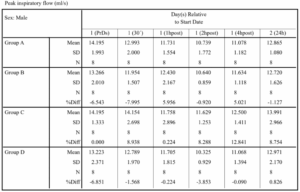
The primary objective of Phase I was to establish a robust historical dataset of respiratory function parameters in healthy, untreated rats. This dataset allowed for the characterization of biological variability and the definition of reference ranges for respiratory function parameters.
Phase II: Validation of the Plethysmography System
The objective of Phase II was to validate the sensitivity and suitability of the WBP system for detecting bronchodilatory and bronchoconstrictive effects on respiratory function in rats. The validation process included two key assessments:
- Bronchodilatory Effects of Theophylline
- The expected bronchodilatory effects of theophylline (administered orally) were compared with saline controls administered via different routes (oral, intravenous, subcutaneous).
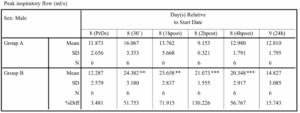
Table 2 shows the changes in peak inspiratory flow after oral administration of vehicle (Group A) vs. positive control (Group B). A T-test showed significant differences between treatment groups:
- 30 min post-administration: A vs. B → p < 0.01
- 1 hour post-administration: A vs. B → p < 0.01
- 2 hours post-administration: A vs. B → p < 0.001
- 4 hours post-administration: A vs. B → p < 0.001
- Bronchoconstrictive Effects of Methacholine
To assess the system’s ability to detect bronchoconstrictive effects, methacholine was administered intravenously and compared with saline controls.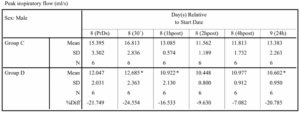
Table 3: Peak inspiratory parameter after intravenous administration of vehicle (Group C) vs. positive control (Group D). Significant differences were observed in the T-test results:
- 30 min post-administration: C vs. D → p < 0.05
- 1 hour post-administration: C vs. D → p < 0.05
- 24 hours post-administration: C vs. D → p < 0.05
Cardiovascular Safety Pharmacology Studies
In addition to respiratory assessments, comprehensive cardiovascular safety pharmacology studies are essential to evaluate potential drug-induced effects on the heart and vasculature. These studies aim to detect adverse drug effects on the cardiovascular system before clinical trials, determine the cardiovascular safety margin of new drugs, and identify potential mechanisms behind any cardiotoxicities.
Irwin Test
The Irwin test is a systematic observational method developed to comprehensively assess the behavioral, neurological, and autonomic state of rodents through direct observation. It is used to identify subtle neurological perturbations produced by a drug and to control for other behavioral and locomotor assays.
Contribution to the 3Rs Principle
By confirming the expected effects of theophylline and methacholine, this validation process eliminates the need to repeat these tests with positive controls in future studies. This significantly contributes to the Reduction (R) principle of the 3Rs (Replacement, Reduction, Refinement), helping to minimize the number of animals required in subsequent experiments.
Conclusion
Whole Body Plethysmography serves as a valuable, non-invasive tool for assessing respiratory function in preclinical safety pharmacology studies. Its ability to detect both bronchodilatory and bronchoconstrictive effects without the use of anesthesia makes it essential for evaluating the respiratory impact of new drug candidates. Alongside cardiovascular assessments and CNS evaluations like the Irwin test, WBP contributes to a comprehensive safety profile for new pharmaceuticals, ensuring potential adverse effects are identified before clinical trials.
References
- ICH S7A (2000). Safety Pharmacology Studies for Human Pharmaceuticals. International Conference on Harmonization of Technical Requirements for Registration of Pharmaceuticals for Human Use.
- ICH S7B (2001). The Non-clinical Evaluation of the Potential for Delayed Ventricular Repolarization (QT Interval Prolongation) by Human Pharmaceuticals. International Conference on Harmonization.
- ICH M3(R2) (2009). Guidance on Nonclinical Safety Studies for the Conduct of Human Clinical Trials and Marketing Authorization for Pharmaceuticals. International Conference on Harmonization.